
 English
 Russian
 Portuguese
 Arabic
 Bangla
 Indonesian
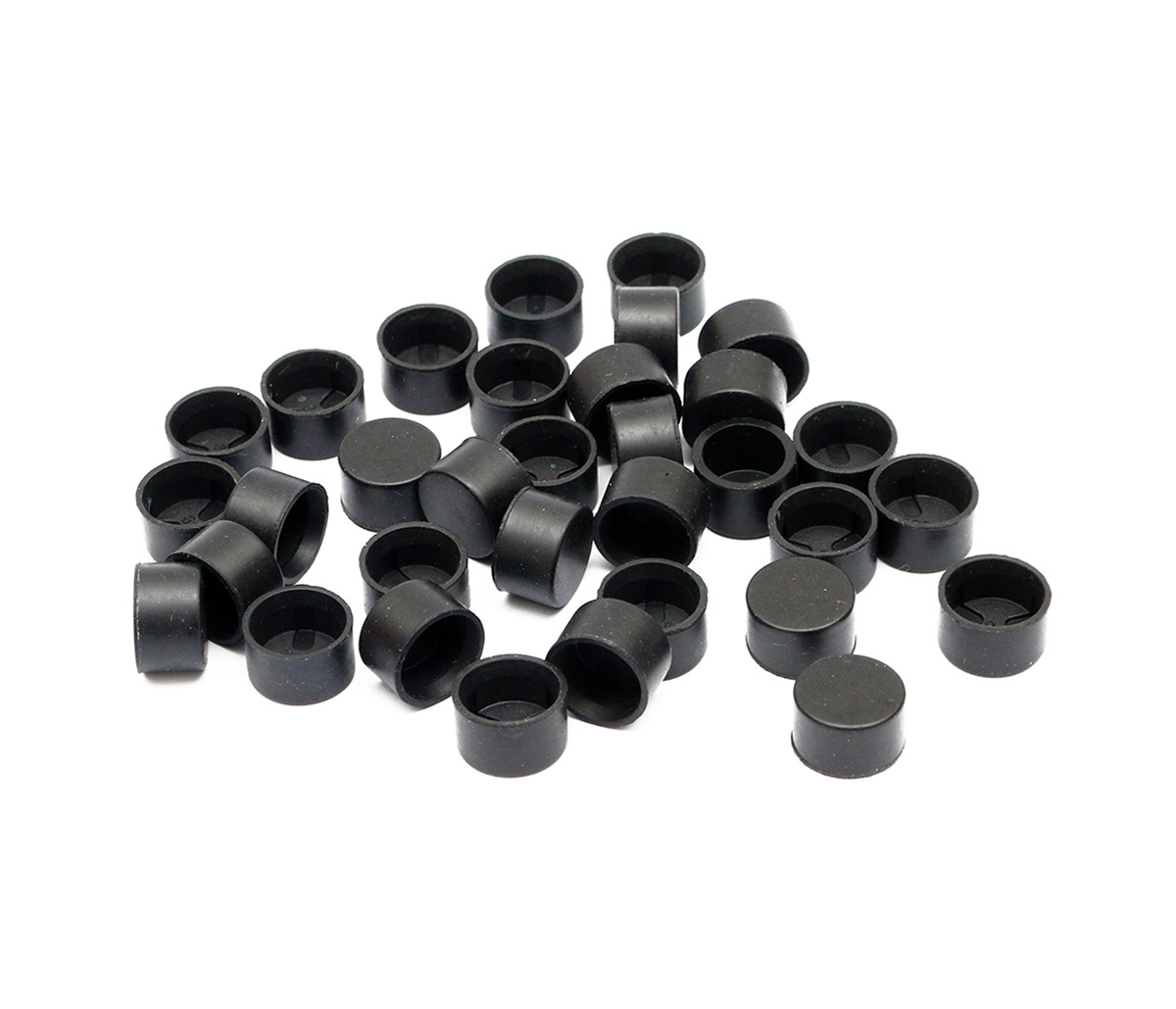

EPDM Rubber Caps — The Better Solution for Lead‑Acid Batteries
- By: JinHan
- May 18,2026
follow us
Rubber caps on lead-acid batteries — also called vent caps or valve caps — are easy to overlook. They're small, they're cheap, and they don't show up on any spec sheet highlight.
But if you've ever dealt with battery field failures, you know the truth: a bad rubber cap causes real problems.
Hardened rubber that won't seal. Swollen caps that block venting. Cracks that leak acid. Pressure instability that affects battery performance. A lot of these issues trace back to one thing — the wrong material.
Why EPDM? Let's go through the details.
1. Acid resistance that holds up
Lead-acid batteries run on sulfuric acid. That's not a friendly environment for most materials.
Some rubbers (like natural rubber) degrade quickly in acid. They harden, crack, and lose flexibility. Others swell when exposed to acid, changing shape and blocking the vent path.
EPDM sits in the sweet spot. It resists acid attack without hardening or swelling. Even after months of continuous exposure, the material properties stay within a reasonable range. That means fewer seal failures and less acid leakage in the field.
2. Compression set — the real test of a rubber cap
Here's what happens inside a battery: the rubber cap gets compressed against its seat, held there for days or weeks, then released. Over and over again.
If the material has poor recovery, it takes a "set" — meaning it stays flattened. Once that happens, sealing pressure drops. Venting pressure changes. And eventually, the cap stops doing its job.
EPDM is known for low compression set. Push it down for a long time, and when you release it, it bounces back close to its original shape. That's not true for all rubbers. NR and NBR, for example, generally perform worse in this specific test.
We've run internal compression set tests at 70°C for 22 hours. EPDM consistently comes back above 80% of its original thickness. That's the kind of number that translates to real-world durability.
3. Temperature range that covers real use
Batteries don't live in a lab. They sit in engine compartments, outdoor enclosures, and hot warehouses. They deal with cold starts in winter and heat spikes during heavy charging.
EPDM handles approximately -30°C to 120°C for continuous use. Short-term exposure can go higher.
At low temperatures, EPDM stays flexible. No cracking. No brittle failure. At high temperatures, it resists aging and hardening better than many general-purpose rubbers.
For lead-acid battery applications — including automotive, UPS, and basic energy storage — that range is sufficient. If you need extreme heat resistance beyond 150°C, then FKM (Viton) is the right answer. But for most customers, that's overkill.
4. Cost without cutting corners
We could spec FKM on every rubber cap. It would perform well. But it would also cost two to three times more.
We could spec the cheapest NR blend. It would lower our cost. But customers would see failures within a year.
EPDM sits in the middle. It costs more than basic NR, but significantly less than FKM. The performance, however, is much closer to FKM than to NR for acid and aging resistance. That's what we call practical value — paying for what actually matters, not for maximum theoretical performance.
5. Proven track record — not a trend
One more thing worth saying: EPDM isn't new. It's not a "breakthrough material" or a marketing gimmick. It has been used in lead-acid battery components for decades.
That's actually a good thing.
A mature material means predictable behavior, stable supply chains, and fewer surprises. When we ship EPDM rubber caps, we know exactly how they will perform one year or two years later. No guesswork. No "we'll see."
If you're sourcing rubber caps and your current material is giving you trouble — cracking, hardening, leaking — EPDM is worth a try. We don't claim it's perfect for every single application. But we do know it works for most. And that's why we use it.
--End--
-
 Yang Du Senior Engineer | Storage Battery Expert
✓ 28 years of experience in storage-battery separators
✓ Expert in PE separator production and testing
✓ Senior Manager at CTMT
✓ B.Eng. in Chemical Engineering, Hebei University of Technology
✓ Managed PE separator cooperation projects with Exide, Enersys, JCI
-
 Hong Chen Standardization Expert | Youth Entrepreneurship Tutor
✓ Vice Chairman, China Physical Chemistry Power Industry Association
✓ Zhejiang "Ten Thousand Talents" Leading Talent
✓ 80+ national patents / 20+ monographs
✓ Contributed to 10+ international & national standards
✓ National Sci-Tech Progress Award (3rd prize) -
 Xianzhang Wu Senior Engineer | Energy Storage Expert
✓ Vice Chairman, China Physical Chemistry Power Industry Association
✓ Zhejiang "Ten Thousand Talents" Leading Talent
✓ 80+ national patents / 20+ monographs
✓ Contributed to 10+ international & national standards
✓ National Sci-Tech Progress Award (3rd prize) -
 Guangjun Zang Senior Engineer | Lead-Acid Battery Expert
✓ 35 years in lead acid battery industry
✓ Expert in battery materials, design and engineering
✓ Technical Project Leader for NT AGM VRLA batteries
✓ Specializes in tubular battery R&D and quality control
✓ Supplies technical support to domestic battery manufacturers
-
 Fang Liu Senior Manager | Bilingual Expert
✓ 23 years of in-depth experience in English translation
✓ Master's in TESOL, University of South Australia
✓ Skilled in cross-border client communication & technical translation
✓ Former senior teacher & US visiting scholar
✓ Experienced in employee management and team building
-
 Wei Shan


