
 English
 Russian
 Portuguese
 Arabic
 Bangla
 Indonesian

India's Lead-Acid Battery Market Keeps Growing as Recycling Compliance Rewrites the Rules
- By: JinHan
- Sep 07,2026
follow us
The market is still growing
India's lead-acid battery demand isn't going anywhere. Industry forecasts point to steady long-term growth for flooded lead-acid in the country.
A few things are driving it.
Telecom is one. India is building out 5G, and that means more small cell sites and edge data centres needing backup power. Existing telecom tower battery banks are also being upgraded — backup time is stretching from a few hours to 8-12 hours in some cases. That's continuous replacement demand, not a one-time bump.
Rural off-grid solar is another. A lot of households in India still don't have reliable grid access. Government solar programs keep deploying off-grid storage, and lead-acid still has a cost advantage there. It won't be replaced overnight.
Data centres are spreading out too — from Mumbai, Chennai, and Bengaluru into Pune, Hyderabad, Ahmedabad. That pushes demand for large-format industrial lead-acid batteries.
The market itself is concentrated. Exide and Amara Raja are the two big players, together holding more than half the market. The top five account for the vast majority. If you want to sell into India, getting into their supply chains is basically the main path.
Recycling compliance is changing the game
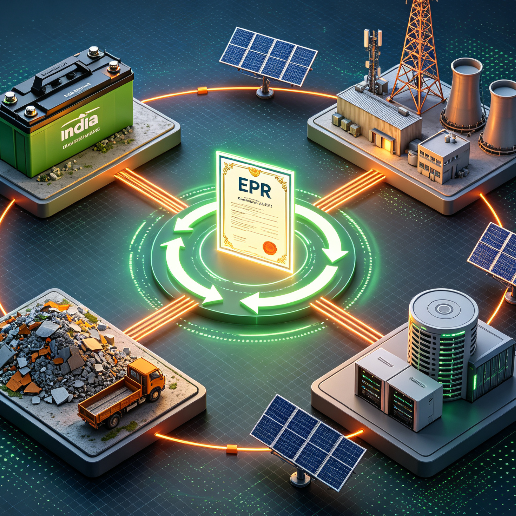
India rolled out the Battery Waste Management Rules in 2022. The core of it is an EPR framework — battery producers have to make sure a certain share of end-of-life batteries get formally recycled, and they prove it by buying EPR certificates.
Sounds straightforward. But the implementation details are causing friction.
The Indian Battery Manufacturers Association — Exide, Amara Raja, Luminous, Livguard, Okaya, and others — has been pushing back. They've submitted proposals to the Environment Ministry and CPCB asking for revisions.
Here's the dispute. Under current rules, if a battery maker recycles batteries through its own in-house capacity, the EPR certificates generated still have to be listed on a digital platform for anonymous trading. There's no guarantee the original producer gets those certificates back. IBMA says that's double charging, and it discourages companies from investing in their own recycling infrastructure.
The industry claims a recycling rate above 97%. But a lot of spent batteries still flow into informal channels — cash transactions, unregulated recyclers. The headline number and the formal-channel number are not the same thing. That gap is exactly what the EPR framework is trying to close.
What this means if you export to India
A few things worth watching.
Compliance costs may work their way into the supply chain. If IBMA's requests don't get accepted, formal battery makers will face higher recycling costs. That eventually passes upstream and downstream. It's a medium-to-long-term thing, not something that will move orders next month.
More formal recycling investment could support lead supply. Major Indian battery makers are expanding recycling capacity. Amara Raja keeps scaling up its in-house lead recycling, and most of its lead and lead alloy feedstock already comes from recycled sources. If formal recycling rates rise, India's reliance on imported primary lead may gradually decline. But that creates new demand for better recycling equipment and technology.
Technical standards are getting tighter. CPCB released Standard Operating Procedures for used lead-acid battery recycling in 2024. It sets clear requirements for plant licensing, pollution control, emission limits, and worker health monitoring. If you supply recycling-related equipment or materials to India, you need to meet these standards.
-
 Yang Du Senior Engineer | Storage Battery Expert
✓ 28 years of experience in storage-battery separators
✓ Expert in PE separator production and testing
✓ Senior Manager at CTMT
✓ B.Eng. in Chemical Engineering, Hebei University of Technology
✓ Managed PE separator cooperation projects with Exide, Enersys, JCI
-
 Hong Chen Standardization Expert | Youth Entrepreneurship Tutor
✓ Vice Chairman, China Physical Chemistry Power Industry Association
✓ Zhejiang "Ten Thousand Talents" Leading Talent
✓ 80+ national patents / 20+ monographs
✓ Contributed to 10+ international & national standards
✓ National Sci-Tech Progress Award (3rd prize) -
 Xianzhang Wu Senior Engineer | Energy Storage Expert
✓ Vice Chairman, China Physical Chemistry Power Industry Association
✓ Zhejiang "Ten Thousand Talents" Leading Talent
✓ 80+ national patents / 20+ monographs
✓ Contributed to 10+ international & national standards
✓ National Sci-Tech Progress Award (3rd prize) -
 Guangjun Zang Senior Engineer | Lead-Acid Battery Expert
✓ 35 years in lead acid battery industry
✓ Expert in battery materials, design and engineering
✓ Technical Project Leader for NT AGM VRLA batteries
✓ Specializes in tubular battery R&D and quality control
✓ Supplies technical support to domestic battery manufacturers
-
 Fang Liu Senior Manager | Bilingual Expert
✓ 23 years of in-depth experience in English translation
✓ Master's in TESOL, University of South Australia
✓ Skilled in cross-border client communication & technical translation
✓ Former senior teacher & US visiting scholar
✓ Experienced in employee management and team building
-
 Wei Shan


