
 English
 Russian
 Portuguese
 Arabic
 Bangla
 Indonesian

Nigeria’s Lead‑Acid Battery Market Expands as New Recycling Rules Take Shape
- By: JinHan
- Oct 12,2026
follow us
The market keeps expanding
Nigeria’s demand for lead‑acid batteries remains strong. Industry outlooks predict stable long‑term growth across the country.
Several key factors are fueling this trend.
Power instability is the biggest driver. A large number of businesses and households depend on backup power systems, requiring plenty of lead‑acid batteries for generators and UPS. Old batteries need frequent replacement, creating steady repeat orders.
Off‑grid solar development is another major driver. Many remote communities still lack reliable grid electricity. Solar‑storage systems are widely adopted, and lead‑acid batteries remain an economical choice despite new alternatives. They will not disappear anytime soon.
Fast‑growing construction and telecom sectors also push up consumption. Telecom firms keep expanding base stations across rural areas, while construction sites need reliable standby power.
The local market is dominated by a few well‑known suppliers. These top players control most of the domestic business. To sell into Nigeria, building connections with their supply chains is a practical route.
Recycling compliance is reshaping the industry
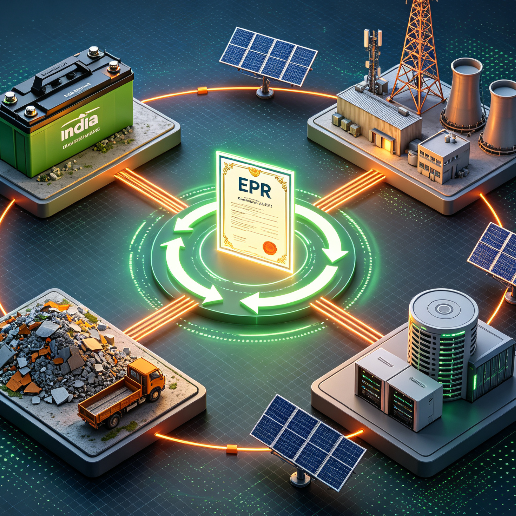
Nigeria has begun rolling out new waste battery management regulations. The core goal is to set up an EPR (Extended Producer Responsibility) system. Battery manufacturers must ensure a required percentage of end‑of‑life batteries go into official recycling channels, and they need to obtain valid compliance certificates.
On the ground, however, implementation brings many challenges. Local industry groups have put forward suggestions to adjust some rules.
One main debate lies in self‑run recycling. If a producer recycles used batteries at its own plant, there are still unclear rules for EPR certificate allocation. Companies worry they may face double‑cost pressure, which reduces motivation to invest in in‑house recycling facilities.
Officially reported recycling rates look high, yet huge volumes of spent batteries still flow into unregulated informal traders through cash deals. There is a big gap between official statistics and real formal‑channel volumes. The new EPR policy aims to shrink this gap.
What this means if you export to Nigeria
Here are several points exporters should watch closely.
First, compliance costs will gradually spread through the whole supply chain. If the new rules are strictly carried out, local battery makers will bear higher recycling expenses. These extra costs will be passed to upstream and downstream partners. This will be a mid‑to‑long‑term shift instead of an immediate change for orders.
Second, increased formal recycling investment may change lead raw‑material supplies. Major Nigerian battery producers are starting to build their own recycling plants. More recycled lead will become available in future years, which could slowly lower reliance on imported primary lead. This will also create fresh demand for recycling equipment and related materials.
Third, technical standards are getting stricter. Regulators are working on formal operating standards for waste lead‑acid battery recycling. New rules will cover factory licensing, pollution control, emission limits, and staff safety protection. If you export recycling‑related equipment or raw materials to Nigeria, your products must satisfy these official standards.
-
 Yang Du Senior Engineer | Storage Battery Expert
✓ 28 years of experience in storage-battery separators
✓ Expert in PE separator production and testing
✓ Senior Manager at CTMT
✓ B.Eng. in Chemical Engineering, Hebei University of Technology
✓ Managed PE separator cooperation projects with Exide, Enersys, JCI
-
 Hong Chen Standardization Expert | Youth Entrepreneurship Tutor
✓ Vice Chairman, China Physical Chemistry Power Industry Association
✓ Zhejiang "Ten Thousand Talents" Leading Talent
✓ 80+ national patents / 20+ monographs
✓ Contributed to 10+ international & national standards
✓ National Sci-Tech Progress Award (3rd prize) -
 Xianzhang Wu Senior Engineer | Energy Storage Expert
✓ Vice Chairman, China Physical Chemistry Power Industry Association
✓ Zhejiang "Ten Thousand Talents" Leading Talent
✓ 80+ national patents / 20+ monographs
✓ Contributed to 10+ international & national standards
✓ National Sci-Tech Progress Award (3rd prize) -
 Guangjun Zang Senior Engineer | Lead-Acid Battery Expert
✓ 35 years in lead acid battery industry
✓ Expert in battery materials, design and engineering
✓ Technical Project Leader for NT AGM VRLA batteries
✓ Specializes in tubular battery R&D and quality control
✓ Supplies technical support to domestic battery manufacturers
-
 Fang Liu Senior Manager | Bilingual Expert
✓ 23 years of in-depth experience in English translation
✓ Master's in TESOL, University of South Australia
✓ Skilled in cross-border client communication & technical translation
✓ Former senior teacher & US visiting scholar
✓ Experienced in employee management and team building
-
 Wei Shan


