
 English
 Russian
 Portuguese
 Arabic
 Bangla
 Indonesian

AGM Vent Plug Failures: What Goes Wrong
- By: JinHan
- Aug 03,2026
follow us
Click HERE to view our products!
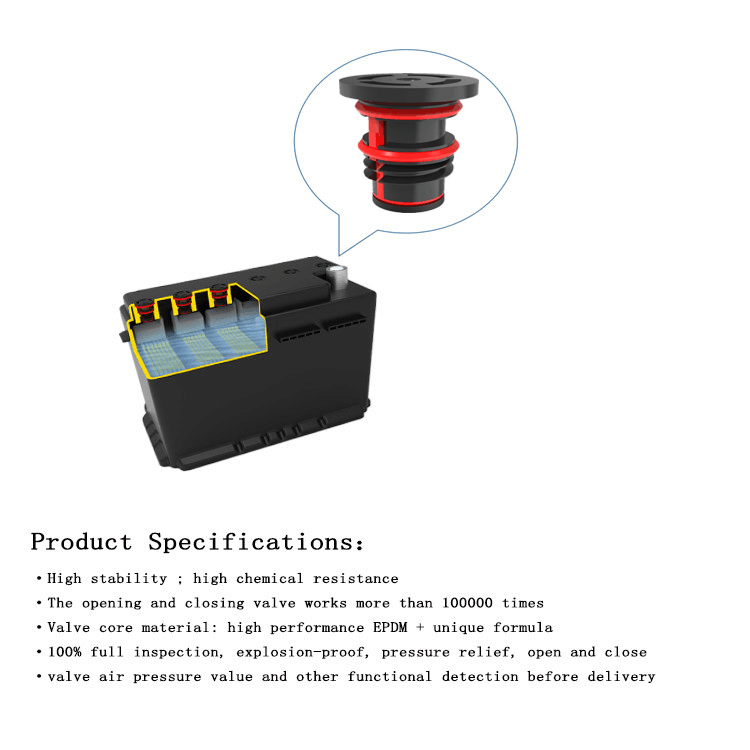
When a vent plug fails — what actually happens? Let's walk through the failure modes one by one.
Stuck open
This is the quieter failure mode. The vent plug stays open, so the battery never builds enough internal pressure. That might sound harmless on the surface — after all, the gas has a way out, so there's no risk of bursting. But that's exactly the problem.
AGM batteries rely on oxygen recombination to keep their water balance. During charging, oxygen generated at the positive plate migrates through the separator to the negative plate, where it recombines with hydrogen to form water. This recombination process requires a minimum internal pressure to function efficiently — typically 1 to 3 PSI, depending on the design.
If the vent plug is stuck open, that pressure never builds. Oxygen recombination efficiency drops. The negative plate never gets fully reduced. Water is lost — not through external leakage, but through incomplete recombination. The electrolyte slowly dries out. Acid concentration rises. The separator shrinks slightly. Internal resistance increases.
The battery doesn't fail overnight. It loses capacity gradually. The customer notices the battery doesn't hold charge as long. It seems to age faster than expected. Most people assume the battery is just old. But in reality, the vent plug killed it — quietly, slowly, and long before its design life.
Stuck closed
This one is more dramatic. The vent plug won't open, so pressure keeps building inside the battery. Every charge cycle adds more hydrogen. The pressure climbs. At some point, something has to give.
The most common outcome is case bulging. The bottom and top surfaces bow outward. The battery no longer fits properly in the mounting tray. The top cover seal lifts slightly, and acid starts seeping through the gap.
If the pressure continues to build beyond that, the terminal seals can fail. Acid creeps up the posts, corrodes the terminals, and makes the battery look like it's leaking — even though the vent plug is the real culprit.
In extreme cases, the battery can rupture. Not a fireball explosion — but a sudden failure of the case, spraying acid. It's rare, but it happens. And when it does, it's not just a warranty claim. It's a safety incident.
What causes a stuck plug? Often just debris inside the valve seat. Or a rubber sealing element that's deformed, softened, or swollen from acid exposure. Or a spring that's lost its force over time. The cause varies. The outcome doesn't.
Pressure drift
This one sneaks up slowly. The vent plug doesn't fail completely — it just stops opening at the right pressure.
If the opening pressure drifts downward, the plug opens too early. Acid mist escapes through the vent along with the gas. White corrosion appears around the vent area. The battery loses acid content. Capacity drops.
If the opening pressure drifts upward, the plug opens too late. The battery spends more time at higher internal pressure than it was designed for. The case is under constant stress. The seals at the terminals are pushed harder. The internal structure of the battery ages faster. Cycle life shortens.
Pressure drift is harder to catch than a stuck plug because there's no single moment of failure. It just gets worse gradually. By the time anyone notices the symptoms — reduced capacity, shorter cycle life, unexplained failures — the vent plug has been off-spec for months. The damage is already done.
Leakage around the plug
This is a sealing issue, not a valve issue. The vent plug has an outer surface that contacts the battery cover. If that interface doesn't seal properly, acid leaks out around the outside of the plug — not through the vent path, but around the plug's outer body.
It doesn't have to be a large leak. Just a tiny film of acid creeping along the surface. Over time, that acid corrodes the terminals, eats away at the battery cover material, and leaves white crystal deposits that make the battery look like it's falling apart.
The battery itself might still be in good condition inside. But the external leakage tells a different story to the customer. They don't look at the internals — they just see a battery that's leaking acid and assume the whole thing is defective.
This failure mode is often caused by undersized or oversized O-ring seals, poor surface finish on the plug or the cover mating surface, or simply the wrong material that shrinks or swells over time. It's a simple problem with simple prevention — but only if you pay attention to the interface design.
-
 Yang Du Senior Engineer | Storage Battery Expert
✓ 28 years of experience in storage-battery separators
✓ Expert in PE separator production and testing
✓ Senior Manager at CTMT
✓ B.Eng. in Chemical Engineering, Hebei University of Technology
✓ Managed PE separator cooperation projects with Exide, Enersys, JCI
-
 Hong Chen Standardization Expert | Youth Entrepreneurship Tutor
✓ Vice Chairman, China Physical Chemistry Power Industry Association
✓ Zhejiang "Ten Thousand Talents" Leading Talent
✓ 80+ national patents / 20+ monographs
✓ Contributed to 10+ international & national standards
✓ National Sci-Tech Progress Award (3rd prize) -
 Xianzhang Wu Senior Engineer | Energy Storage Expert
✓ Vice Chairman, China Physical Chemistry Power Industry Association
✓ Zhejiang "Ten Thousand Talents" Leading Talent
✓ 80+ national patents / 20+ monographs
✓ Contributed to 10+ international & national standards
✓ National Sci-Tech Progress Award (3rd prize) -
 Guangjun Zang Senior Engineer | Lead-Acid Battery Expert
✓ 35 years in lead acid battery industry
✓ Expert in battery materials, design and engineering
✓ Technical Project Leader for NT AGM VRLA batteries
✓ Specializes in tubular battery R&D and quality control
✓ Supplies technical support to domestic battery manufacturers
-
 Fang Liu Senior Manager | Bilingual Expert
✓ 23 years of in-depth experience in English translation
✓ Master's in TESOL, University of South Australia
✓ Skilled in cross-border client communication & technical translation
✓ Former senior teacher & US visiting scholar
✓ Experienced in employee management and team building
-
 Wei Shan


