
 English
 Russian
 Portuguese
 Arabic
 Bangla
 Indonesian

Battery O-Rings: Small Parts, but Leaks Usually Trace Back to Them
- By: JinHan
- Jul 06,2026
follow us
Where O-rings are used in a battery? Three main locations.
1. Terminal post sealing. The post passes through the battery cover — that's the most common path for acid to seep out. The O-ring sits between the post and the cover, compressed to form a seal. Once this fails, acid creeps up the post, terminals corrode, contact resistance rises, and the battery fails quickly.
2. Vent cap sealing. The vent cap and the cover need a seal, but the vent still has to breathe. The O-ring here has to block acid mist from escaping without blocking the vent path. This one is trickier than terminal sealing.
3. Terminal base. Some designs add an O-ring at the base of the terminal to prevent acid from seeping through the thread gap.
At any of these three positions, if the O-ring fails, the result is the same: acid leakage.
Material choices — what we've learned. Let's go through the common materials based on what we've actually seen in use.
NBR (Nitrile Butadiene Rubber)
Good oil resistance, low cost, and many battery plants used it in the early days. But in a sulfuric acid environment, NBR doesn't perform well. Over time it hardens, shrinks, and loses elasticity. We've seen NBR O-rings turn as hard as plastic after two years — they break when pried.
Not saying NBR can't be used at all. But for long-term acid exposure in lead-acid batteries, it's not the best choice.
EPDM (Ethylene Propylene Diene Monomer)
We wrote about EPDM for rubber caps before. O-rings are the same story. EPDM is stable in sulfuric acid — no swelling, no hardening. Low compression set. Push it down and it bounces back.
EPDM's temperature range covers lead-acid battery requirements. Costs more than NBR, but significantly less than FKM. Most of our O-rings are EPDM.
FKM (Fluorocarbon Rubber)
Best chemical resistance, best high-temperature performance, and the highest cost. For most lead-acid batteries, FKM is overkill. Only needed in extreme heat or special chemical exposure.
Silicone
Good temperature resistance and good elasticity. But it doesn't hold up in acid. Silicone degrades in sulfuric acid — not suitable for lead-acid batteries. Occasionally a customer asks about silicone, and we tell them straight: it won't work.
What typically goes wrong with O-rings?
We've gone through customer failure cases and found the issues cluster around a few areas.
Wrong material. The most common problem. Using NBR or ordinary NR (natural rubber) O-rings that don't survive a year in acid. Customers say "the old O-ring aged" — but it's not aging, it's the wrong material for the environment.
Incorrect hardness. Too hard, and the O-ring doesn't compress enough to seal properly — acid leaks. Too soft, and it deforms too much under pressure, eventually squeezing out or losing recovery. For lead-acid battery O-rings, we typically recommend Shore A 70±5. But the actual number depends on the design.
Dimension mismatch. Wrong cross-section diameter or wrong inner diameter throws off the compression rate. O-ring compression rate should be between 15% and 30% to work properly. Many customers bring us old O-rings to copy — but the old ones are already deformed, so copying them just reproduces the problem.
Surface defects. Flash, burrs, bubbles — these molding defects are only visible under magnification. But on a battery, one tiny defect is a path for acid to escape. We do visual checks before shipping. Batch-level full inspection isn't practical cost-wise, but we at least ensure no visible defects in each batch.
How we check O-ring quality? A few simple methods we use:
1. Visual inspection. Smooth surface, no flash, no obvious mold lines. Flat parting line. Even color. Uneven or off-color suggests regrind material was used.
Hand feel. Squeeze it. How fast does it bounce back? Slow recovery usually means poor compression set.
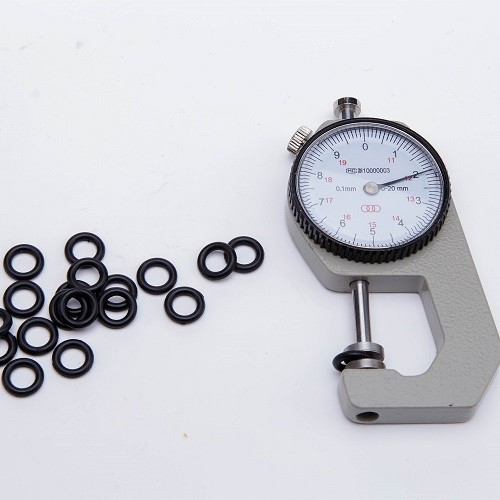
2. Dimension check. Inner diameter, outer diameter, cross-section — measured with calipers or a projector. Anything out of tolerance gets rejected. O-rings are small, but tolerances are tight.
3. Acid soak test. Simple one. Drop it in 1.28 specific gravity sulfuric acid at room temperature for a week. Check for swelling, color change, or tackiness. A good O-ring comes out looking the same as it went in.
Click HERE to go to the product page.
-
 Yang Du Senior Engineer | Storage Battery Expert
✓ 28 years of experience in storage-battery separators
✓ Expert in PE separator production and testing
✓ Senior Manager at CTMT
✓ B.Eng. in Chemical Engineering, Hebei University of Technology
✓ Managed PE separator cooperation projects with Exide, Enersys, JCI
-
 Hong Chen Standardization Expert | Youth Entrepreneurship Tutor
✓ Vice Chairman, China Physical Chemistry Power Industry Association
✓ Zhejiang "Ten Thousand Talents" Leading Talent
✓ 80+ national patents / 20+ monographs
✓ Contributed to 10+ international & national standards
✓ National Sci-Tech Progress Award (3rd prize) -
 Xianzhang Wu Senior Engineer | Energy Storage Expert
✓ Vice Chairman, China Physical Chemistry Power Industry Association
✓ Zhejiang "Ten Thousand Talents" Leading Talent
✓ 80+ national patents / 20+ monographs
✓ Contributed to 10+ international & national standards
✓ National Sci-Tech Progress Award (3rd prize) -
 Guangjun Zang Senior Engineer | Lead-Acid Battery Expert
✓ 35 years in lead acid battery industry
✓ Expert in battery materials, design and engineering
✓ Technical Project Leader for NT AGM VRLA batteries
✓ Specializes in tubular battery R&D and quality control
✓ Supplies technical support to domestic battery manufacturers
-
 Fang Liu Senior Manager | Bilingual Expert
✓ 23 years of in-depth experience in English translation
✓ Master's in TESOL, University of South Australia
✓ Skilled in cross-border client communication & technical translation
✓ Former senior teacher & US visiting scholar
✓ Experienced in employee management and team building
-
 Wei Shan


